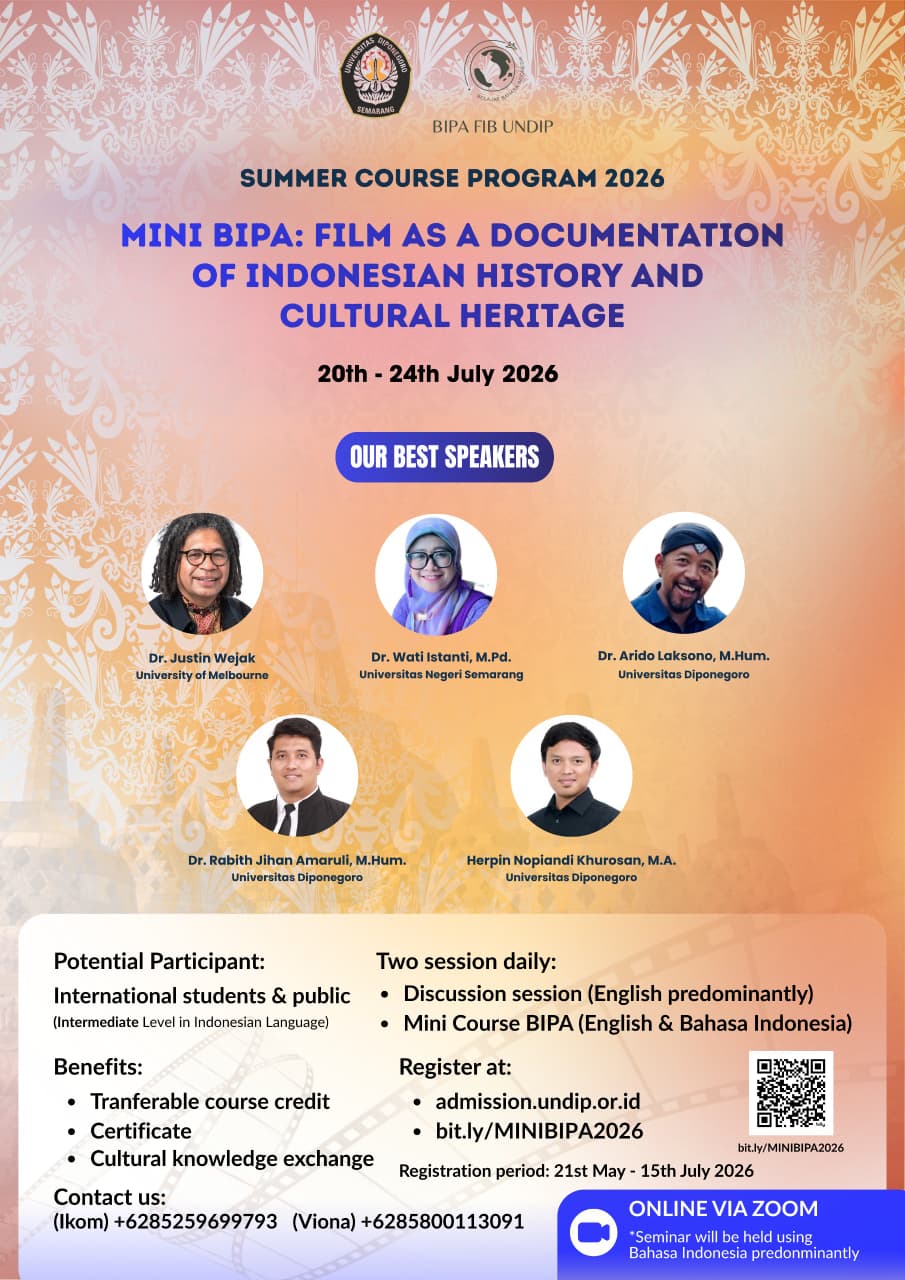
Can films do more than entertain? Can they preserve collective memory, document historical events, and introduce a nation’s cultural identity to the world? These questions became the central focus of the MINI BIPA Summer Course Program 2026, organized by the Undergraduate Indonesian Literature Study Program, Faculty of Humanities, Universitas Diponegoro (FIB UNDIP), from 20 to 24 July 2026.
Under the theme “Film as a Documentation of Indonesian History and Cultural Heritage,” the five-day international program invited participants to explore the role of Indonesian cinema as a medium for preserving history, documenting cultural heritage, and fostering cross-cultural understanding. More than simply learning the Indonesian language, participants discovered how films serve as powerful narratives that reflect Indonesia’s diverse traditions, historical experiences, and cultural identity.
Participants from 24 Countries Join the International Program
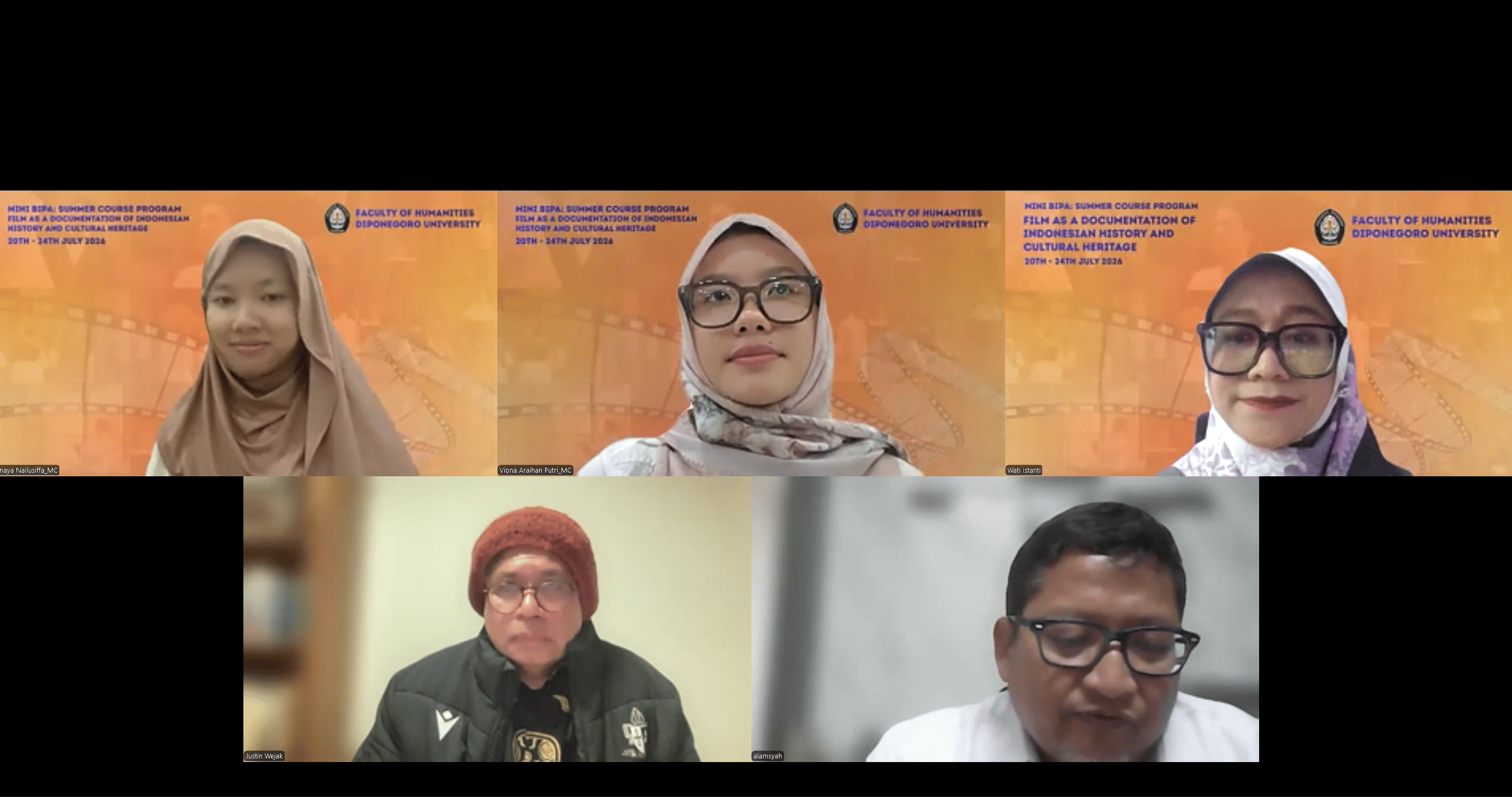
The program was officially inaugurated by the Dean of the Faculty of Humanities, Prof. Alamsyah, M.Hum., who warmly welcomed participants and expressed his appreciation for the international enthusiasm shown toward Indonesian language and culture.
This year’s program attracted 63 participants representing 24 countries, including South Korea, India, Peru, Russia, Nigeria, and many others. Throughout the week, participants demonstrated remarkable enthusiasm by actively engaging in discussions, asking questions, and exchanging perspectives during every session.
Learning Indonesian Culture Through Cinema
Over the course of five days, participants attended lectures delivered by distinguished scholars from Indonesia and abroad, each offering unique perspectives on Indonesian cinema as a cultural and historical resource.
The program opened with Dr. Justin Wejak from the University of Melbourne, who examined how documentary films capture significant moments in Indonesian history through his lecture, “Indonesian History in Documentary Films.” His presentation highlighted the role of documentary cinema as a valuable historical record that preserves collective memory and provides alternative perspectives on Indonesia’s past.
The following session featured Dr. Rabith Jihan Amaruli, M.Hum. from Universitas Diponegoro, who explored documentary films as archives of Indonesian history, emphasizing their contribution to historical preservation and public understanding of national identity.
Participants then explored another dimension of Indonesian culture through Dr. Arido Laksono, M.Hum., whose lecture on “Cuisine in Indonesian Cinema” demonstrated how food in film represents cultural identity, local traditions, and the diversity of Indonesian society.
On the fourth day, Herpin Nopiandi Khurosan, M.A., also from Universitas Diponegoro, discussed the representation of Indonesian traditional culture in film, illustrating how cinematic narratives preserve local wisdom while introducing Indonesia’s rich cultural heritage to global audiences.
Complementing the thematic lectures, Dr. Wati Istanti, M.Pd. from Universitas Negeri Semarang conducted daily Indonesian language short courses, providing participants with practical language skills that enriched their understanding of the films and facilitated intercultural communication throughout the program.
Encouraging Dialogue Through Student Presentations
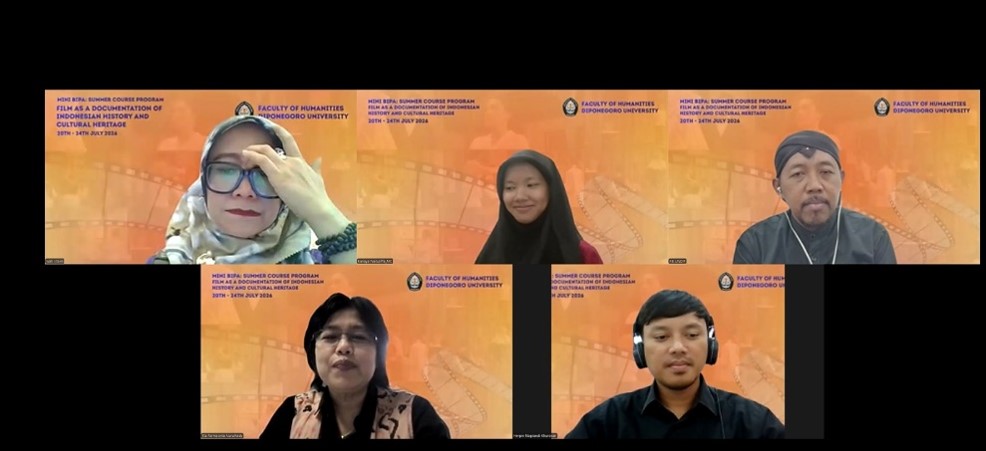
The final day of the program was dedicated to participant presentations, where attendees shared their reflections and analyses under the direct guidance of the invited speakers. This interactive session created valuable opportunities for intellectual exchange, allowing participants to discuss their ideas while receiving constructive feedback from experts in Indonesian language, culture, and film studies.
The program concluded with closing remarks delivered by Eta Farmacelia Nurulhady, S.S., M.Hum., M.A., Ph.D., representing the Faculty of Humanities, Universitas Diponegoro. She emphasized that the success of the MINI BIPA Summer Course 2026 reflects the Faculty’s continued commitment to promoting international education through meaningful cultural exchange while strengthening Universitas Diponegoro’s position as a globally engaged university.
Ultimately, the program demonstrated that films can serve as more than visual entertainment. They function as cultural archives, historical documents, and powerful educational tools that connect people across linguistic and national boundaries. Through cinema, participants not only learned the Indonesian language but also gained deeper insights into Indonesia’s history, traditions, and cultural identity.
By bringing together participants from around the world, the MINI BIPA Summer Course 2026 successfully created a vibrant space for intercultural dialogue—one where stories on screen became bridges connecting diverse cultures and inspiring greater appreciation for Indonesia’s rich historical and cultural heritage.